

Most women do not wake up one day and suddenly feel older. The shift often begins much earlier, long before meaningful changes appear in the skin. It begins in the stories we absorb, the predictions we hear, and the expectations quietly settling into the background of how we see ourselves. Many women are introduced to an idea of aging years before they fully experience it. Forty becomes a threshold. Menopause becomes a category with assumptions already attached. Midlife becomes something many women feel they should already understand before they have even lived it.
The language often arrives before the biology does. Long before a woman develops her own understanding of aging, she has usually been introduced to someone else’s version of it through headlines, advertising, social media, filtered images, cultural narratives, and passing comments that quietly become familiar.
That is where expectation becomes interesting.
The brain does not simply observe reality with perfect neutrality. It predicts, filters, compares, and searches for patterns. Research in psychology and neuroscience suggests expectation can influence what we notice, how we interpret what we notice, and how strongly we believe those observations confirm what we already think is true.
At a very simplified level, the brain may be asking a quiet question in the background:
What do I think is about to happen?
The answer may influence where attention goes next. If the expectation is decline, attention may begin gathering evidence around decline. If the expectation is support, adaptation, possibility, or resilience, the search changes. Biology remains real, yet the lens through which it is viewed may shift.
Beauty may not sit outside this process.
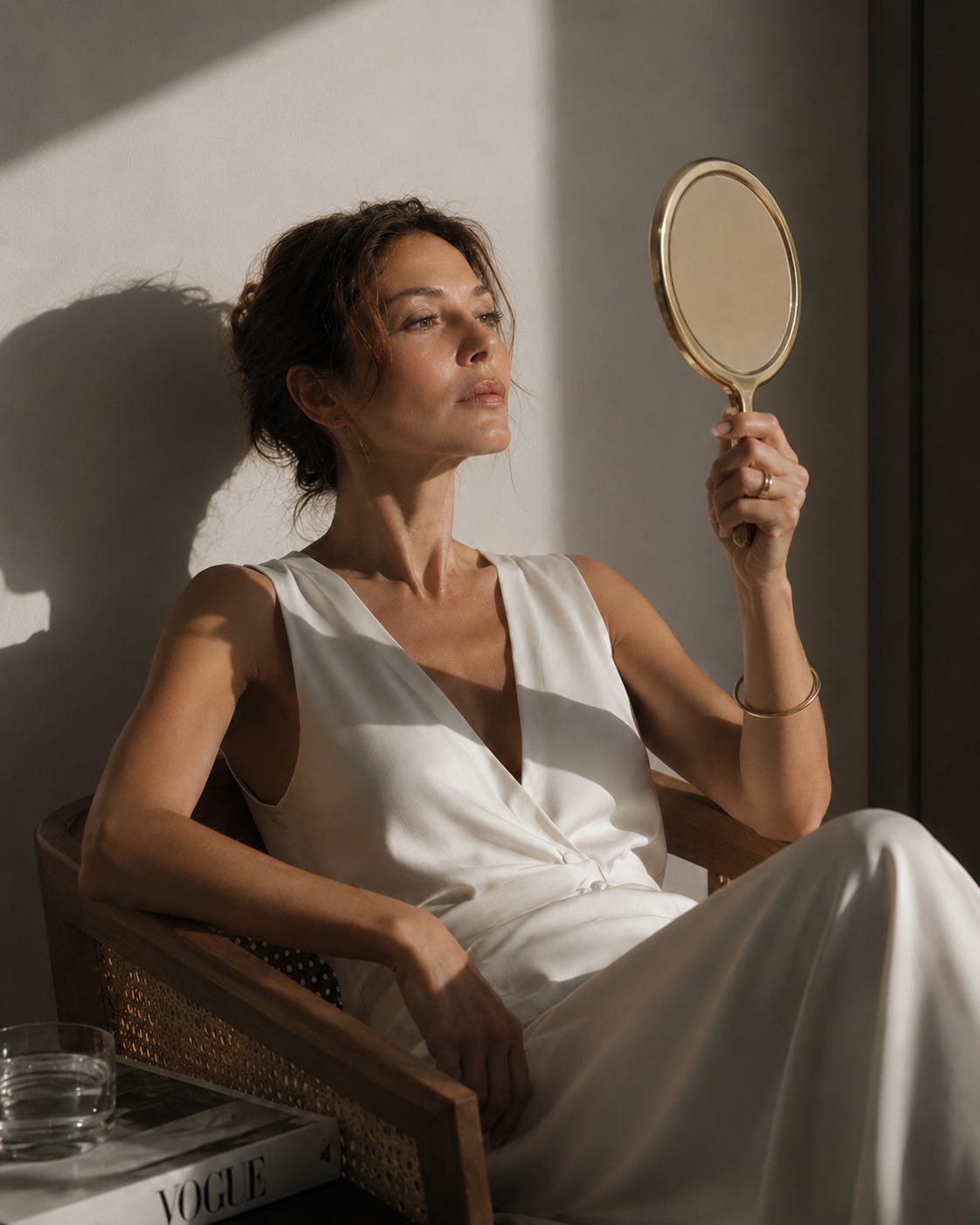
If a woman expects decline, she may begin looking for evidence of it with greater intensity. Texture becomes more noticeable. Softness feels more significant. A photograph becomes less about memory and more about evaluation. The mirror shifts from reflection into investigation.
This is not vanity. It may be conditioning.
The beauty industry has spent decades teaching women what to monitor, correct, soften, restore, prevent, and improve. Far less attention has been given to how expectation changes the act of looking itself.
What interests me most is what happens after an expectation forms. Expectations rarely remain abstract. They influence attention, and attention influences interpretation. Over time, interpretation can begin shaping behavior.
A woman who quietly believes she is entering decline may start relating to herself differently before major biological changes fully arrive. She may become more critical in front of the mirror, less experimental with style, more hesitant in photographs, or more focused on confirming fears she never consciously chose.
The body may not have changed dramatically, yet the relationship to it has. That distinction deserves more attention.
As the relationship shifts, daily choices often shift with it. Sleep can be affected by stress. Movement may become less consistent when self-image changes. Food choices may become more reactive or restrictive. Confidence can soften. Visibility can shrink. At that point expectation is no longer simply an idea. It has entered behavior.
Expectation does not erase biology. It does not stop collagen loss, override hormones, or make aging disappear. The more interesting question is whether expectation influences the experience surrounding aging, the choices made around it, and the way a woman participates in her own longevity.
I think many women carry assumptions about aging years before those experiences fully arrive. Some come from advertising. Some come from social media. Others arrive through family conversations, cultural beliefs, beauty messaging, medical language, trends, and quiet remarks that slowly become internal.
Eventually those ideas stop sounding external.
They begin sounding personal.
That may be one of the least discussed influences in modern beauty: anticipation.
What did a woman expect to see before she looked?
What did she believe would happen before it happened?
What story was already waiting for her when she entered a new decade, moved through hormonal change, looked at a photograph, or noticed a shift she had been expecting for years?
The question is not whether women should ignore aging.
The question is whether women have been taught to approach aging already prepared for loss.
If expectation becomes decline, the body may begin feeling like something to manage instead of something to support. The mirror becomes a checkpoint. The face becomes evidence. Time becomes negotiation rather than participation.
There is another way to approach it.
A woman can acknowledge biological change without surrendering to every inherited assumption surrounding it. She can support her skin, body, mind, and lifestyle without turning herself into a project of endless correction.
Aging is real and change is real.
The meaning attached to those changes may not be.
One of the most powerful questions in beauty is not What was I told aging would look like? It may be What story am I choosing to carry forward?
That question changes the mirror. It shifts attention away from inherited expectations and toward authorship. It asks women to examine not only the visible signs of aging, but the invisible narratives standing beside them.
The next evolution of beauty may not be found in resisting age, but in refusing to inherit its limits
.