

This isn’t just skincare.
It’s early conditioning—and our daughters are the target.
The goal isn’t to raise girls who reject beauty.
It’s to raise girls who understand it.
That distinction matters more now than ever.
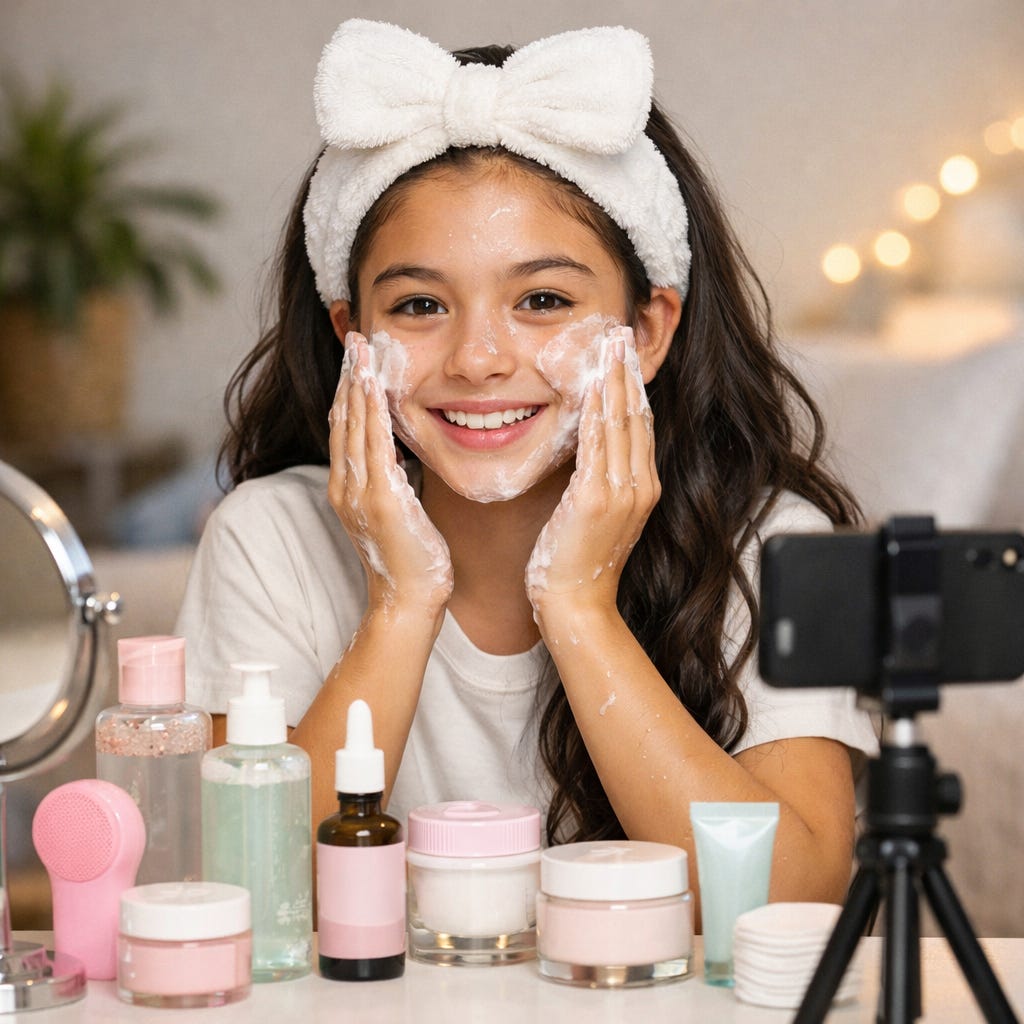
It starts in familiar places. Ulta. Sephora. A glowing screen propped against a sink. A child standing in front of a wall of products designed for adult skin. A mother saying no. A reaction that feels disproportionate to the moment, because the moment isn’t really about a product. It’s about belonging. About fluency in a language that has quietly become social currency far earlier than it used to.
What we’re witnessing is culturally overdue to be named.
Beauty is no longer something girls grow into. It’s something they’re being trained to perform.
On TikTok, YouTube, Instagram, and Shorts, beauty unfolds as ritual. “Get Ready With Me” videos, or GRWM, filmed in softly lit bathrooms. Product hauls arranged just so. Acrylic nails tapping bottles for effect. Sheet masks peeled open with ceremony. Star-shaped acne patches worn like accessories. Under-eye patches placed more for aesthetics than anatomy. Serums layered because a routine feels “incomplete,” not because skin requires them.
This isn’t rebellion.
It’s literacy—acquired before comprehension.
Children’s skin, hair, and nails are not smaller versions of adult systems. They are biologically different and still developing. The skin barrier is thinner and more permeable. Transepidermal water loss is higher. Sebaceous activity remains low until puberty, meaning young skin does not have the oil production or resilience many adult-formulated products assume. The skin microbiome undergoes continuous development from infancy through adolescence, with significant shifts occurring during puberty. The delicate eye area, in particular, is highly susceptible to irritation; products placed too close can migrate into the eye, triggering puffiness, dryness, and inflammation.
These are not theories. They are fundamentals of pediatric dermatology.
And yet, adult beauty routines are being normalized for girls who haven’t reached puberty.
If you’re a parent today, you’ll recognize the names that dominate these routines online. Brands like Bubble, Byoma, Touchland, Sol de Janeiro, Laneige, Summer Fridays, and legacy lines like Clinique appear again and again—alongside contouring products, hair-slicking brushes, eyelash curlers, and press-on or glued nails that are meant to “slay,” plus cosmetic treatments framed as playful upgrades rather than adult decisions. These are just some of the names and products circulating constantly online, not all of them, but together they form a recognizable aesthetic vocabulary for girls barely out of childhood.
A growing category of viral beauty content centers on sensory-driven products, such as jelly-textured makeup, gel blushes, and sheer lip tints. These formulas are designed less for performance and more for visual appeal, thriving on social platforms where texture, shine, and “glass-skin” effects translate into highly shareable moments. These products are designed to perform on screen, where aesthetics and shareability often outweigh skin-based necessity.
The issue isn’t that these products exist.
It’s that popularity is being mistaken for age-appropriateness.
Cosmetic safety testing is conducted using adult exposure models: adult skin, adult detox pathways, adult physiology. What science does show is that children absorb topical substances differently, and that repeated exposure to fragrance and alcohol-heavy formulations increases the likelihood of irritation and sensitization in young skin. What science does not need to claim is guaranteed harm to make the point. Developing systems deserve margin and restraint—not trend-driven excess.
But chemistry alone doesn’t explain what’s happening.
Early exposure trains the nervous system, not just the skin.
What young girls are learning isn’t skincare.
It’s conditional worth.
The pattern being installed is subtle but powerful: fix before there’s a problem. Enhance before you understand. Someone else knows your body better than you do. When beauty routines arrive before self-concept, they don’t empower—they condition. This isn’t beauty education. It’s identity outsourcing.
Children copy routines they don’t understand. They layer products without purpose. They perform adulthood before biology is ready. And when children perform adult rituals without understanding, the ritual becomes the authority.
It hurts when daughters trust strangers over mothers. But this isn’t about intelligence or defiance. It’s about repetition, aesthetics, and perceived belonging. Influence doesn’t require expertise. It requires proximity and repetition. Which is why a teenage influencer with perfect lighting can quietly outrank a mother’s lived knowledge—even when that mother is a professional.
As someone who works in this industry, and as a mother of a daughter in this age range, I see this from both sides. Somewhere between a request for serums because a routine feels “incomplete,” questions about eye creams and face-framing highlights, and—most recently—being asked for an eyelash lift, the picture becomes unmistakably clear. If you don’t know what an eyelash lift is, Google it. It’s not something you’d ever expect a nine-year-old to ask for, or even have a frame of reference for. And yet she did. Not because she understands what it involves, but because it exists in the beauty language she’s absorbing online. That moment wasn’t about wanting longer lashes. It was about wanting fluency in a world that’s teaching girls what to want long before they understand what they’re asking for.
So the answer isn’t removal.
It’s education.
Beauty doesn’t need to be banned.
It needs to be taught in sequence.
At younger ages, beauty is hygiene, protection, and ritual. Gentle cleansing. Simple moisturization. Sun protection. Clean hair care. Nails kept short and healthy. Beauty as care.
Later, beauty becomes experimentation. Makeup as expression. Hair as identity. Skincare as support, not correction.
And eventually, beauty becomes strategy—when the skin, nervous system, and hormones are mature enough to respond appropriately.
The conversations that land aren’t lectures. They’re reframes.
“This isn’t about never—it’s about not yet.”
“Some products are designed for grown skin.”
“Beauty should support you, not rush you.”
“Pretty doesn’t equal informed.”
“Who benefits if you believe you need this?”
You’re not competing with influencers.
You’re building internal authority.
And that’s the parenting pivot.
This conversation also asks something quietly important of the industry. When brands know their imagery, packaging, and social reach extend to children, responsibility follows. Not moral panic. Just context. Transparency. Age awareness.
Our daughters don’t need more products.
They need adults who understand biology, influence, and self-worth—and who are willing to hold that line calmly, confidently, unapologetically.
Not so they fear beauty when they get older.
But so they develop a healthy relationship with it—one where beauty is a tool, not an emotional requirement. An enhancement, not a measure of worth.
That isn’t restrictive.
That’s intelligent.
And it’s the kind of beauty that lasts.