

My mornings do not begin with productivity. They begin with 8+ ounces of lemon water for cellular hydration before anything else. It is a quiet signal to the body that replenishment comes first. If time allows, I lie with my legs up the wall to support circulation, letting gravity assist what sleep could not fully restore. Then gentle movement to wake everything up. Hips, shoulders, spine. A torso twist, a plank, downward dog. Nothing dramatic. Just enough to remind my body we are participating in the day.
Then facial work. Gua sha brushes first, followed by more detailed sculpting with stones when time allows. The LYMA cold laser is part of this rhythm. Not occasionally, but consistently. It is one of the few precision light technologies I prioritize because its benefit compounds with regular use. Even here, time is always negotiating with intention.
From there, I move into personal care rituals that support internal and external reset. Tongue scraping comes first, an elevated oral detox practice rooted in traditional medicine that removes overnight bacterial buildup and stimulates digestion before the day begins. Then brushing my teeth, brushing my hair, and applying a lightweight tinted moisturizer with SPF to bring the skin to life while providing quiet daily protection, a small gesture of readiness in case the morning expands beyond a simple school drop off, before transitioning from restoration into responsibility.
Real life enters quickly. I let the dog out, pack my daughter’s lunch, wake her, make her breakfast, and get her out the door for school. Only then do I return to structured wellness.
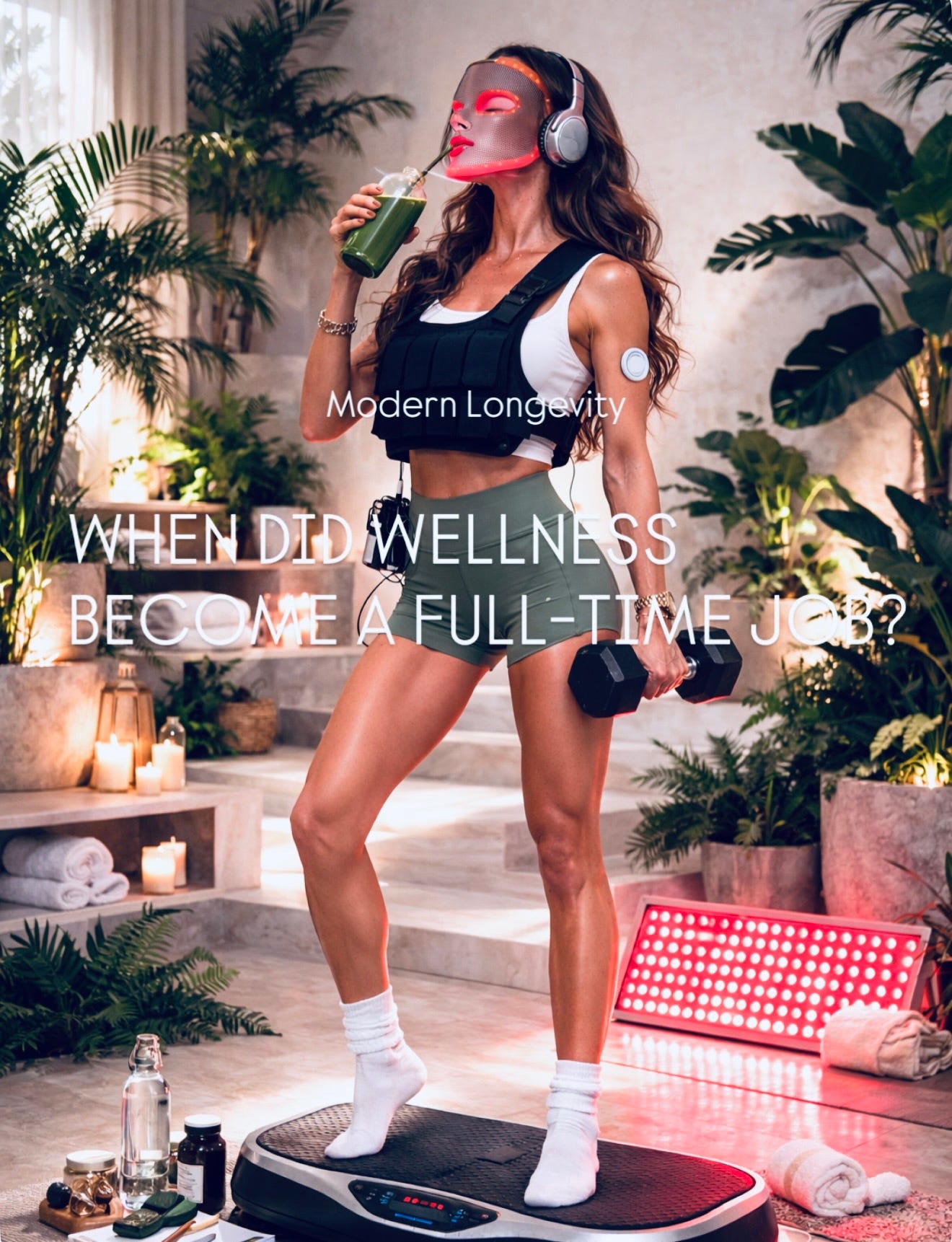
Danger coffee or mushroom matcha, depending on what my nervous system needs, part of a more nutrient-forward approach to morning energy. If the schedule permits, red light therapy. One cycle for collagen. Another for contour. Then the vibration plate. Then either a walk with the dog or a Pilates or strength training class.
After movement, if the morning has not collapsed under logistics, I apply bioactive oil to my scalp and hair and step into the infrared sauna for thirty to forty minutes. Heat, stillness, recovery. Then dry brushing, a shower, and a cold rinse to finish. If time is tight, the sauna shifts later into the day.
Supplements are spaced throughout the day. Some with food. Some without. Some timed. Some rotated. Evenings often become a second opportunity for whatever did not fit earlier. Red light therapy if needed. Sauna if postponed. The acupuncture mat. The weighted vest. And if the LYMA laser was not completed earlier, it becomes part of the evening wind-down, a quiet precision ritual before the body transitions into overnight repair.
And woven between all of this is life. Running a home. Grocery shopping. Errands. A daughter in competitive dance, which is less an activity and more an entire ecosystem of rehearsals, travel, and scheduling. A puppy who does not acknowledge structured optimization. A husband and shared household rhythms that require presence, attention, and time. Writing. Researching. Producing content. Building a business. Working on my book. Staying current with the constant expansion of longevity science.
Then there is the layer no schedule accounts for, yet many women live inside. Perimenopause. Menopause. Interrupted sleep. Fatigue that does not negotiate. Brain fog that arrives without warning. A body already adapting internally before external optimization is layered on top.
Somewhere inside the accumulation of everything I practice, teach, and attempt to sustain alongside real life, a thought returns to me almost daily. There is no way this is sustainable for most people. Not without unusual time freedom. Not without significant financial resources. Not without minimizing other responsibilities.
That is when the question surfaced clearly enough that I could not ignore it.
Is my wellness routine employing me full time?
Something subtle has happened in modern health culture. No one consciously decided to build a life around managing dozens of wellness interventions. It accumulated gradually. One beneficial practice at a time. One helpful device. One promising protocol. One insight from research. One recommendation from an expert. One routine shared online that felt too valuable to ignore.
Each addition made sense individually. Together, they formed a system that requires management. A system that demands time, attention, scheduling, and consistency. A system that never stabilizes because innovation never stops.
At some point, many people stop asking whether something is beneficial and start asking where it fits into the day. That is the moment wellness shifts from supportive to operational.
The list continues to grow. Wearable devices tracking sleep, recovery, glucose, heart rate variability. Grounding mats promising nervous system regulation. Face taping to retrain muscle patterns overnight. Compression systems. Light panels. Data dashboards. Morning routines that resemble performance schedules. Evening routines that require preparation.
Online, longevity now lives in two parallel realities. One aspirational and beautifully structured. The other quietly comedic. People layered in devices, protocols, and recovery tools like highly optimized ecosystems. Both reveal the same truth. Health has become something people manage rather than something people live inside.
The tools are not the problem. Many of them are genuinely beneficial. Strength training preserves muscle and metabolic health. Heat exposure supports cardiovascular resilience. Light therapies influence tissue repair and cellular signaling. Targeted recovery improves mobility. Medical grade treatments can meaningfully support skin, energy, and function. Innovation has expanded what is possible for human health, and that is something worth respecting.
The issue is not effectiveness. The issue is accumulation.
Human physiology is adaptive, but it is not infinitely scalable. The body improves through cycles of stimulus followed by recovery and integration, not through continuous activation. Effort followed by rest. Input followed by absorption. Continuous intervention, continuous monitoring, and continuous optimization create demand, even when the intention is health.
For women over forty, especially those navigating perimenopause or menopause, this becomes even more relevant. The body is already recalibrating. Sleep shifts. Stress sensitivity increases. Recovery fluctuates. Adding escalating layers of intervention on top of an already adaptive system can amplify strain rather than relieve it.
The more important question is not whether these practices work. It is whether they are sustainable inside real life.
This is where a more intelligent structure becomes necessary. This is the foundation of what I call the Core 2 Beauty Three-Layer Model of Sustainable Longevity.
Most people are not overwhelmed because longevity is complicated. They are overwhelmed because everything is treated as equally necessary.
A more intelligent structure separates health into three distinct layers.
Layer 1 is foundational and non negotiable. Sleep quality, movement and strength, nutrition that supports metabolic stability, stress regulation, consistent recovery rhythms, and topical skincare that protects, repairs, and preserves the integrity of the skin barrier. These produce the majority of long term physiological benefit.
Layer 2 consists of strategic enhancements used rotationally. Red light therapy phases, sauna cycles, targeted mobility or fascial work, focused supplementation blocks, and structured recovery tools. These are used intentionally, not continuously.
Layer 3 includes precision or clinical interventions delivered in concentrated form. Medical grade treatments, in office regenerative therapies, and advanced monitoring or corrective protocols. These provide higher intensity stimulus with greater efficiency and lower frequency, reducing the need for constant daily intervention.
The mistake most people make is trying to live in all three layers every day.
Human physiology does not require that level of simultaneity. It responds beautifully to rhythm.
Longevity is not built by maximizing interventions. It is built by maximizing adaptation. Adaptation requires stimulus and space. Effort and integration. Structure and recovery. Without the second half of each pair, the first loses its power.
The goal was never to complete the most protocols. The goal was to feel strong, think clearly, move freely, and live fully engaged in the world, while allowing that internal vitality to express itself visibly through resilient skin, vibrant energy, and a physical presence that reflects the biology of youth.
The most advanced longevity strategy is recognizing when enough has been achieved and allowing the body to live inside the benefits.
When optimization becomes overload, vitality begins to outpace the life it is meant to support.
Longevity was never meant to be lived on a schedule. It was meant to be lived
.