

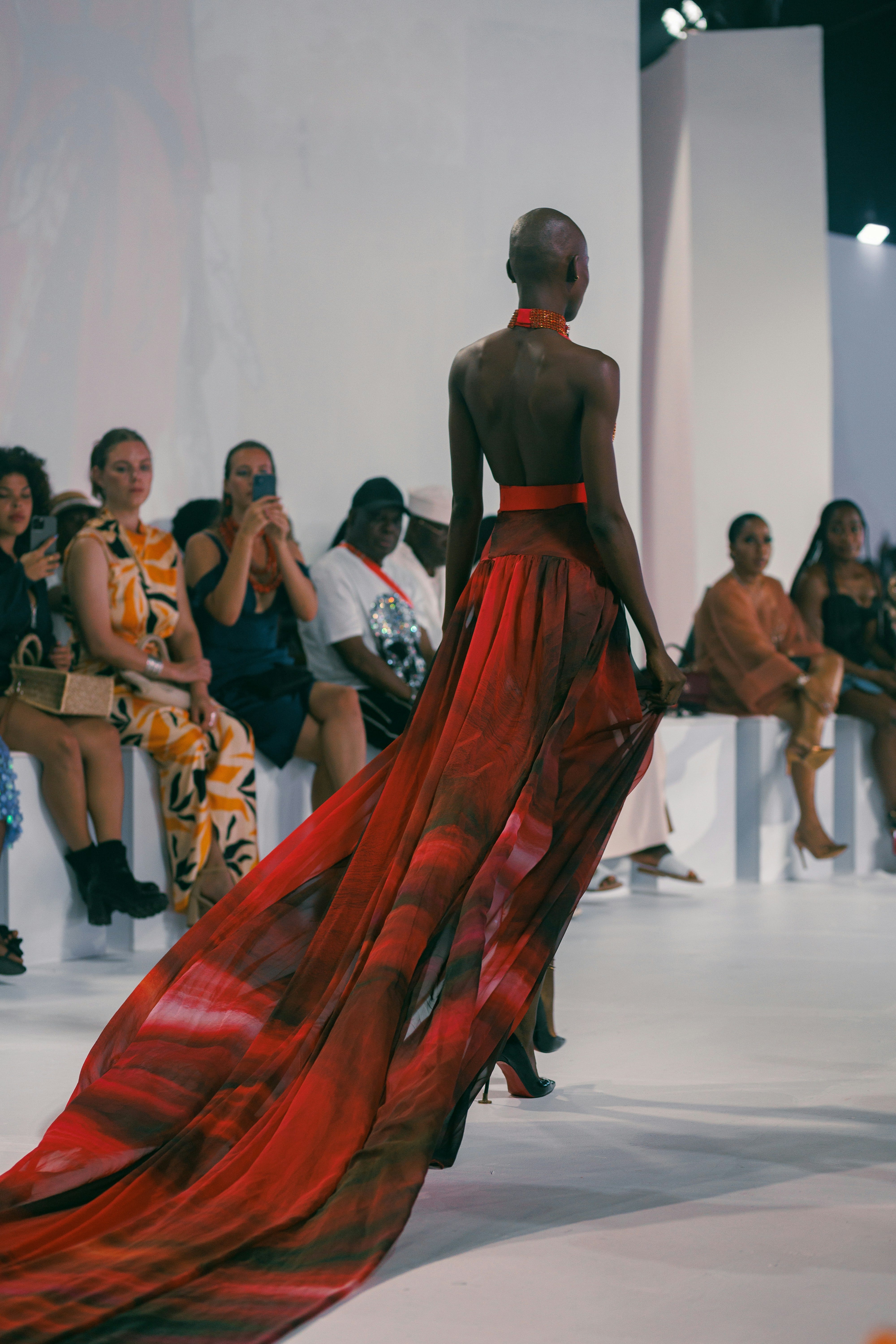
In nineteenth-century Paris, a dress no longer had to be imagined in a static form. It could be watched on a body.
Charles Frederick Worth, the English-born couturier closely associated with the birth of haute couture, helped make the living model part of the fashion house. His wife, Marie Vernet Worth, modeled his designs, and the House of Worth eventually employed trained mannequins to present finished garments directly to clients.
On a living model, the dress had another story to tell. Fabric behaves differently once a person inhabits it. It hangs from shoulders, moves around hips, follows the stride and responds to the position of the spine. The body does not simply wear the garment. It changes the way the garment is seen.
By the turn of the twentieth century, Lucile, Lady Duff Gordon, pushed that idea much further. Her mannequin parades were theatrical productions, and her models were trained not simply to put on clothes, but in carriage and deportment. They learned how to walk, pose and hold themselves. Many were strikingly tall, but height alone wasn’t the performance. Beauty wasn’t enough. Carriage was part of the job.
Fashion would eventually make the elongated figure one of its signatures. Illustrators stretched the body beyond ordinary anatomical proportions, while tall, long-lined models became increasingly familiar in couture and later on the runway. The two helped create the visual language we still recognize immediately as fashion: length, line, proportion and movement.
But look more closely at what those houses were cultivating, and height is only part of the story. Deliberate movement, controlled gestures, a composed turn, a body that could give the garment shape without competing with it.
Those qualities do not belong exclusively to anyone six feet tall. Length may have helped create fashion’s elongated silhouette, but bearing determined how that silhouette moved through a room.
Height was part of fashion’s visual language, and alignment was part of its power. But alignment is available at every height.
And buried inside that history is something much more useful than an argument about model measurements. A beautiful garment can change a silhouette. So can the body underneath it.
We sometimes discover that in a less glamorous setting. A shop window on a bright afternoon, the mirrored wall of a hotel elevator, a candid photograph someone shares before you can decline. You catch sight of a figure, shoulders drawn forward, head arriving a fraction before the rest of the body, and for half a second you register only a stranger, someone older. Then recognition lands, and with it a small, private shock. It is you.
What stops us in that moment is rarely skin. In a passing reflection, no one can read a fine line or a loss of collagen. What we read is shape. The chest has softened inward, and the head has drifted forward as if leaning toward something just out of reach. Before anyone studies a face, the silhouette has already made an impression.
This part of aging rarely comes up in the beauty world. We invest fortunes on the surface of the face while the frame beneath it quietly tells its own story.
Human beings are exquisite readers of the body. We recognize the people we love by their walk alone, at distances where their features dissolve into a blur. Perception researchers have shown that observers can pick up cues about age and emotion from nothing more than points of light placed at the joints of a moving body. No face. No hair. No clothing. Just the way a body holds itself and moves through space.
The body, it turns out, speaks in motion.
Posture is that outline held still. An upright frame, open collarbones, and a head balanced over the shoulders can read as energy, readiness, and self-possession. A more folded frame can suggest fatigue or retreat, whether or not that impression reflects the person inside it.
Consider the vocabulary we use without thinking. A person of integrity is upstanding. Someone facing hardship is told to hold their head high. A difficult season leaves us bowed. Language has long understood what the eye already knows. The vertical line of the body carries meaning far beyond mechanics.
The head moves forward of the shoulders. The upper back rounds. The shoulders roll inward, narrowing the chest. Each change may be small. Together they can alter the apparent height, openness, and proportions of the figure.
The face does not float independently above that figure. It sits at the summit of a structural chain, and the position of that chain changes how we see it.
When the head drifts forward, as it does for so many of us after years spent bent over screens, steering wheels, and desks, the angle between the chin and throat changes. Skin can gather at the neck. The jawline can read softer and heavier. Some of what we notice in the lower face is the position in which we are viewing it.
The load is far from trivial. The adult head weighs roughly ten to twelve pounds when balanced over the spine. Tip it forward and the load on the cervical spine rises; one widely cited biomechanical model estimated it at nearly sixty pounds at a sixty-degree tilt, the deep downward angle familiar to anyone absorbed in a phone. That is an estimate of mechanical load, rather than a prediction of damage, but it helps explain why holding the position can demand more from the neck and upper shoulders.
Try this. Stand in profile to a mirror and let your head drift forward the way it does when you read. Then draw it gently back toward a comfortable position over your shoulders, as though a silk thread were lifting you from the crown. Watch how the angle beneath the jaw changes. Watch how the neck appears to lengthen.
The tissue has not changed. The silhouette has.
And it changes what you are wearing, too.
Much of tailoring is built around a particular stance: the position of the shoulders, the line of the spine, the balance of the body. A slouch does not merely change the wearer. It rewrites the clothing.
Once you know where to look, the evidence is everywhere. A tailored jacket, cut to fall cleanly from the shoulder, can gape at the back of the collar and crease across the upper spine when the head pushes forward. Lapels that should lie flat bow outward. Shoulder seams slide ahead of the actual shoulder. A silk blouse meant to skim the body pools at the waist instead.
The reverse is equally true, and far more thrilling. Posture can improve the way an entire wardrobe hangs. Stand comfortably into your full height and a plain white shirt suddenly looks intentional. A dress falls closer to the long, uninterrupted line its designer imagined.
The most expensive thing you will ever put on may be your own vertical line, and it happens to be free.
Posture is not only something others see. It is something we feel, and the traffic runs in both directions. We slump when we are tired or discouraged, but research suggests the reverse can hold as well. The shape we hold can influence the state we inhabit.
In one study published in Health Psychology, participants who sat upright while facing a stressful task reported higher self-esteem, better mood, and less fear than those seated in a slump. They also spoke more, while the slumped group used more negative-emotion words. Other work found that changing the way people walked could shift what they later remembered. Participants guided into a more depressed style of gait showed a more negative memory bias than those guided into a happier one.
The science is still maturing, and some of the more theatrical early claims about power poses and hormones did not survive closer scrutiny. But a quieter finding remains interesting. The position and movement of the body can influence how we experience ourselves in the moment.
There is breath, too. Body position affects breathing mechanics, and a folded posture can make a full breath feel less easy. And there is presence, the least measurable and most unmistakable effect of all. The way we enter a doorway, take a seat, or turn to greet someone contributes to how we are received.
Anyone who has caught their reflection mid-slump and quietly straightened knows the sensation. It feels less like a correction and more like a return.
It would be too easy to cast the slouch as a pure villain. The body falls into it for reasons. Sometimes it is rest, sometimes protection. And rigid, military uprightness is no better answer. The body was never meant to be locked into one perfect position. It was built to shift, vary, and move.
The trouble begins when the resting shape becomes the habitual one. Long periods spent folded forward can contribute to discomfort and reduced movement. Aesthetically, the position registers too: less apparent height, a more closed chest, clothing that hangs differently, and a silhouette that can read older than the person living inside it.
The hopeful part is that much of the posture is not fixed. It is shaped by strength, mobility, daily habits, and repetition, and many of those things can change. Structural changes such as osteoporosis, spinal compression, or pronounced curvature are different and deserve medical guidance.
But for many of us, the work begins simply: strengthen what supports the frame, restore movement where the body has grown stiff, raise the screen, bring the phone toward the eyes, interrupt long periods of sitting, and pay attention to how you carry yourself.
Bone and muscle are living tissue, which is why resistance exercise, weight-bearing movement, adequate protein, and nutrients that support bone health also belong here.
Posture is not merely something corrected in front of a mirror. It is a lifestyle made visible.
Return, for a moment, to that reflection in the shop window. It lingers because it is often the first time we see aging not as a number or a texture, but as a shape.
The quiet revolution is realizing that some of that shape remains ours to influence. We cannot stop time from passing through the body. We can be far more deliberate about how we carry ourselves through it.
So pause in the doorway before you leave the house. Let the crown lift. Let the shoulders settle. Let the chest open and the gaze come level.
Somewhere inside that small adjustment is a version of you who stands a little taller and feels more fully present. That version has been there all along, waiting for you to rise and meet it.