

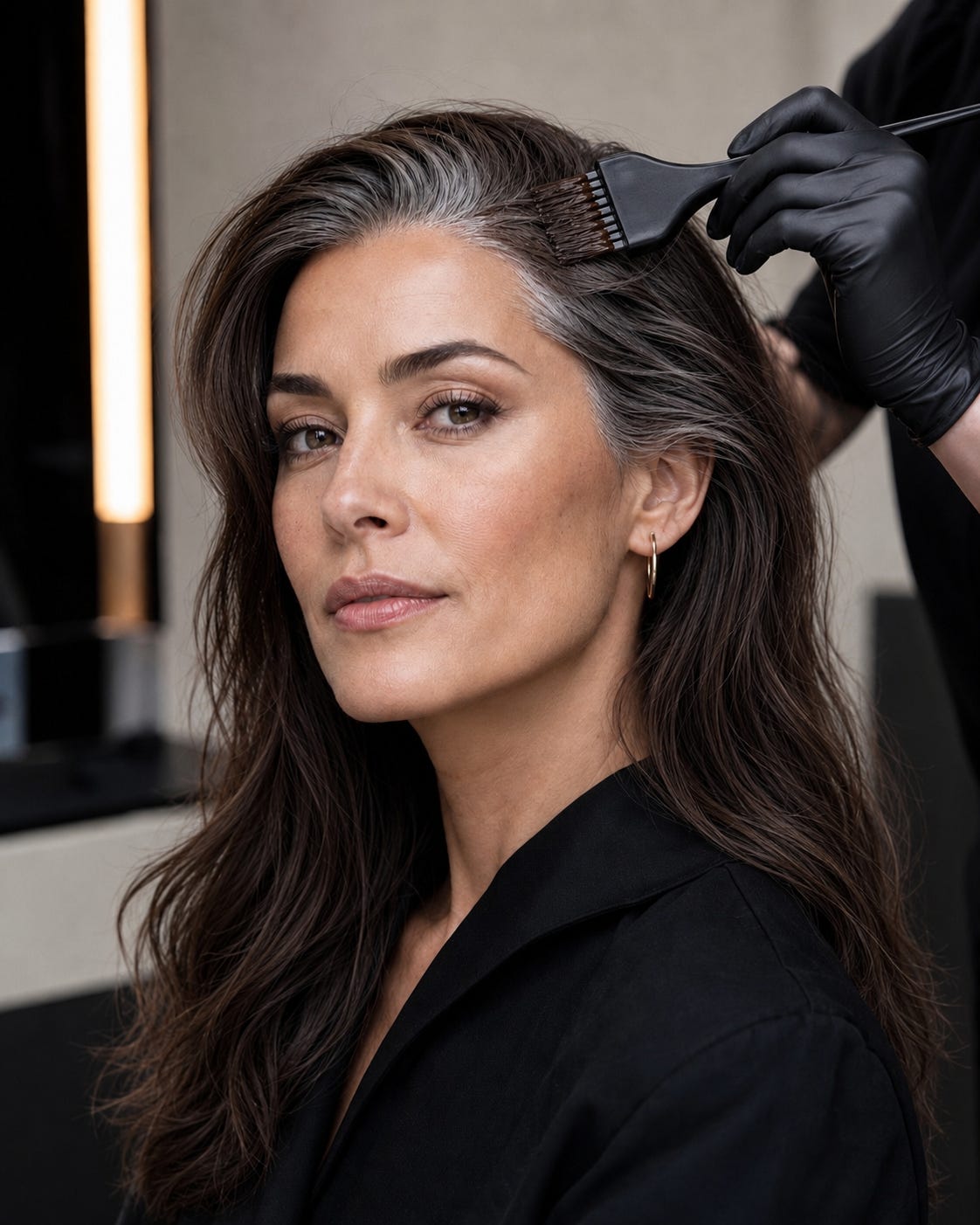
The first gray hair rarely transforms the person looking back at you in the mirror.
What it can transform, almost instantly, is the way you think about yourself.
For many people, that first silver strand carries an unsettling question:
Am I aging faster than everyone else?
It is easy to understand why. We grow up watching older relatives gradually lose their natural hair color. The association becomes almost automatic: dark hair signals youth; silver hair signals age.
Then gray appears in your twenties, thirties or forties, and it can feel as though your body has moved ahead of schedule.
But gray hair is not a reliable measurement of how quickly the whole person is aging.
You can eat exceptionally well, exercise consistently, protect your sleep, avoid smoking and maintain excellent metabolic health, yet still gray years start earlier than someone who pays far less attention to their health.
Healthy habits matter enormously. They simply cannot override every inherited biological timeline.
Hair pigmentation is one of those timelines.
Your follicles may lose pigment early while your cardiovascular health, metabolism, muscle function and cognitive health remain strong. Another person may retain dark hair well into later life while developing health concerns that carry far greater consequences.
Gray hair is highly visible. That does not make it a comprehensive report on the condition of the body beneath it.
The body does not age as one synchronized unit. Different tissues have different vulnerabilities, genetic influences and repair mechanisms. The pigment-producing system inside your hair follicles may begin changing early without the rest of you following the same accelerated path.
Silver at the roots may change how old you appear.
It does not automatically reveal how well, or how quickly, you are aging.
Your Hair May Be Following Its Own Timeline
Gray hair reflects a change within one highly specialized system: the biological machinery responsible for placing pigment into a growing strand of hair.
It does not measure cardiovascular fitness. It does not reveal insulin sensitivity, muscle strength or brain health. Nor does it tell us whether someone has followed an exemplary lifestyle.
This matters because premature graying is a recognized phenomenon, yet people who experience it are still regularly told that they are “too young” to have gray hair.
They are not too young.
Their pigmentation system simply began changing earlier.
Genetics and family history appear to exert the strongest influence over when graying begins and how quickly it progresses. Researchers have identified genetic variants associated with hair graying, although no single gene explains every person’s pattern. Pigment loss likely reflects several interacting processes involving melanocyte stem cells, melanin production and the way the follicle responds to cellular stress.
Ancestry also appears to influence average timing across populations, although population averages cannot predict what will happen to one person. Dermatology literature has generally reported earlier average onset among people of European ancestry, followed by Asian populations, with later average onset among people of African ancestry.
There is considerable variation within every population. These broad classifications should never be treated as fixed biological rules.
Natural hair color may also affect how dramatic the transition appears. There is no convincing evidence that brunettes necessarily lose pigment sooner than blondes. Gray roots are simply more visible against dark brown or black hair. A few millimeters of pale regrowth can create a sharp line of contrast along the hairline or part.
That visibility creates its own experience.
When Two Good Weeks Become the Schedule
For someone with naturally dark hair and extensive gray regrowth, coloring is not always a relaxed appointment every six or eight weeks.
Sometimes the silver begins showing through within one or two.
Hair color starts getting planned around vacations, weddings, work presentations and family photographs. There are permanent dyes, powders, sprays and emergency root touch-up products tucked into bathroom drawers and handbags. Some days you wear your hair down because pulling it back only makes the silver around your temples and hairline more noticeable. Other days, you simply hope the lighting is forgiving, or throw on a hat if the day is more relaxed.
The maintenance can become exhausting, not because gray hair is medically dangerous, but because it repeatedly announces itself.
Premature graying is not only a pigment change. It can become a quiet scheduling system running in the background of a person’s life.
Some people eventually stop coloring and embrace the silver. Others feel more like themselves when their darker color is restored. Neither decision is more enlightened.
The meaningful part is having a choice, rather than being told that one response represents confidence and the other insecurity.
What Is Happening Beneath the Strand?
Hair receives its color while it is forming beneath the skin. Specialized cells called melanocytes produce melanin and transfer it into the growing hair shaft.
Those melanocytes are replenished by melanocyte stem cells located within the follicle. As this system becomes depleted or dysfunctional, less pigment reaches the new strand. The hair emerges gray, silver or white.
A 2023 study published in the peer-reviewed scientific journal Nature added an intriguing layer to this explanation. In mice, researchers found that melanocyte stem cells normally move between different regions of the follicle and shift between more primitive and more mature states.
As the follicles aged, increasing numbers of these cells became stranded in a location where they were less able to receive the signals required to mature and produce pigment.
The cells were not always simply gone.
Some appeared to remain present but functionally stuck.
That finding raised an important scientific possibility: could researchers eventually preserve the movement and flexibility of these cells, or restore their function before pigment production is permanently lost?
Possibly.
But the work was performed in mice, not as a human treatment trial. No commercially available product has been shown to reposition these cells and reliably restore pigment in human scalp hair.
Since that discovery, researchers have continued examining melanocyte stem-cell activation, follicle signaling, cellular aging and the differences between temporary dysfunction and permanent stem-cell depletion. New laboratory models are also being developed to study human hair pigmentation and screen possible treatments more accurately.
This is meaningful progress, but it has not yet produced a proven therapy.
Promising biology is not the same as proven medicine.
Does Stress Really Turn Hair Gray?
Stress may contribute to graying, but it is not the entire explanation, and it does not affect every person in the same way.
Animal research has shown that acute stress can activate the sympathetic nervous system and deplete melanocyte stem cells in mice. This established a plausible biological pathway through which intense stress could influence pigmentation. It did not prove that every stressful experience will turn human hair gray.
Human research has provided a smaller but fascinating clue.
In a 2021 study, researchers mapped pigmentation patterns along individual human hairs and documented some strands that had lost and later regained pigment. In one participant, several hairs regained pigment during a period that included a vacation and lower reported stress. The finding was intriguing, but it did not prove that the vacation itself caused the repigmentation.
The observations were correlational. They did not prove that stress reduction directly caused repigmentation.
That does not mean a week at the beach can recolor an entire head of hair.
What it suggests is more interesting: pigment loss in some individual follicles may remain reversible during a limited biological window.
A follicle that is temporarily impaired may not be biologically equivalent to one whose pigment-producing system has been permanently depleted.
At present, we cannot look at a gray strand and know which situation exists beneath it.
Stress management remains worthwhile for countless reasons. It should not be marketed as guaranteed hair repigmentation.
What About Copper?
Copper deserves a more precise explanation than either “copper reverses gray hair” or “copper has nothing to do with it.”
Copper is required for normal melanin production. It supports tyrosinase, an enzyme involved in pigment synthesis. A genuine copper deficiency can therefore affect pigmentation and other aspects of health.
That is the kernel of truth behind the large number of social-media posts recommending copper for gray hair.
The problem begins when biological necessity is treated as proof that more copper will restore pigment in anyone who is graying.
It will not.
When someone is genuinely deficient, correcting that deficiency may support normal biological function. When copper status is already adequate, taking additional copper has not been shown to reliably reverse genetically programmed or age-related graying. Excess copper can also be harmful.
High-dose zinc deserves attention for the opposite reason. Prolonged zinc supplementation can interfere with copper absorption and, in susceptible people, contribute to copper deficiency.
A nutrient can be essential without becoming a universal treatment.
The same caution applies to vitamin B12, folate, iron, vitamin D and thyroid function. Studies have reported associations between premature graying and some of these abnormalities, but findings are inconsistent. An association does not prove that the abnormality caused the hair to gray.
A clinician may consider B12, folate and thyroid testing when graying begins unusually early, particularly when there is no clear family pattern or when other symptoms are present. A complete blood count, ferritin, iron studies, vitamin D, copper or zinc may also be appropriate depending on the person’s medical history, diet, medications and risk factors.
Correcting a documented deficiency is evidence-based care.
Taking several nutrients “just in case” is not.
Test, do not guess.
Can Lifestyle Accelerate Graying?
Genetics appears to carry the greatest influence, but some modifiable factors may affect the timing or progression of graying.
Smoking is one of the most consistently reported lifestyle associations with premature graying. Oxidative stress, inflammation and cellular damage within the follicle have all been proposed as possible explanations.
Because much of the evidence is observational, it cannot prove that smoking caused every individual case. The association is consistent enough, however, to take seriously.
Certain medical conditions and deficiencies may also contribute in selected people, while significant stress may influence pigmentation in some follicles.
Beyond those factors, the evidence becomes less definitive.
Poor sleep, an unbalanced diet and chronic inflammation can affect overall health. It would still be inaccurate to claim that any one of them independently causes gray hair in everyone.
Nor can we say that a flawless diet, ideal sleep or an expensive wellness routine will preserve pigment indefinitely.
This is where the wellness industry often loses precision. A plausible mechanism becomes a certainty, and a sensible health practice becomes a hair-color treatment.
A healthy lifestyle may create a more supportive environment for the follicle. It cannot guarantee that someone with a strong genetic predisposition will retain pigment.
You can do almost everything “right” and still gray early.
That is not failure.
It is biology.
Are Anti-Gray Supplements and Serums Worth the Money?
The market for delaying or reversing gray hair has grown faster than the evidence supporting it.
Products commonly contain vitamins, minerals, antioxidants, peptides or plant extracts intended to support melanin production. Some ingredients have plausible mechanisms. Some companies report encouraging results from sponsored or internal studies.
The important question is not whether an ingredient sounds scientific.
It is whether the finished product has been evaluated in rigorous human trials, and whether the findings have been peer-reviewed and independently reproduced.
For many commercially available anti-gray products, publicly available evidence remains limited. That does not prove every product is ineffective. It means there is not yet enough high-quality evidence to support broad promises about preventing or reversing ordinary gray hair.
Consumers deserve to understand the difference between a theoretical mechanism, a laboratory experiment, a company-sponsored study, a peer-reviewed clinical trial and a finding reproduced by independent researchers.
Those are not interchangeable levels of proof.
A product may eventually prove helpful for some people, particularly during the earliest stages of pigment loss. It may also create only modest changes that are difficult to see outside a controlled study.
Someone whose melanocyte stem-cell system remains functional may respond differently from someone whose pigment-producing reserve is already depleted.
At present, commercial products cannot reliably tell us who is most likely to benefit.
The anti-aging industry makes an extraordinary amount of money in the distance between hope and evidence.
A thoughtful consumer does not need to reject every innovation.
They need to understand exactly how much certainty they are buying.
Can Gray Hair Reverse?
Occasionally, yes, but that statement requires context.
Individual human hairs have been documented regaining pigment. Repigmentation has also been reported after correction of certain deficiencies, treatment of some underlying conditions and changes involving particular medications.
These cases show that pigment loss is not universally irreversible in every follicle. They do not demonstrate a dependable method for restoring an extensively gray scalp.
A few strands regaining color are not the same as complete repigmentation.
Correcting deficiency-related pigment loss is not the same as reversing inherited stem-cell depletion.
A modest improvement in a small study is not the same as eliminating root maintenance.
The more useful question may be whether a follicle’s pigment-producing system is temporarily impaired or permanently depleted.
That distinction may eventually determine who could benefit from treatment, when an intervention would need to begin and whether preservation is more realistic than reversal.
What Can You Do Now?
There is no proven routine that guarantees the prevention of gray hair. There are still sensible actions to take.
Investigate unusually early or rapidly progressing graying
Begin with family history. When several relatives also grayed young, inherited biology may offer the most likely explanation.
It is still reasonable to discuss unusually early or rapidly progressing graying with a qualified clinician, particularly when it is accompanied by fatigue, hair loss, numbness, weight changes, digestive problems or other symptoms.
Testing should be chosen according to the individual, rather than ordered as a generic anti-aging panel.
Protect what is modifiable
Do not smoke. Prioritize sleep, a nutrient-adequate diet, movement and metabolic health.
These habits cannot overrule genetics, and they should never be presented as gray-hair cures. They support the broader biological environment in which the follicle functions while protecting systems that matter far more than pigment.
Match expectations to the stage of graying
Someone noticing their first strands may reasonably be interested in preserving the pigment that remains, although no method has yet been shown to accomplish this reliably.
Someone who is already substantially gray should be particularly cautious about spending heavily on products promising dramatic reversal. At that stage, choices around coloring, blending or embracing the silver may provide more predictable results than unproven treatments.
What Science May Be Able to Preserve
The most realistic breakthrough may arrive as preservation before it arrives as dramatic reversal.
Researchers may eventually learn how to protect melanocyte stem cells, maintain their movement, preserve the signals that guide their maturation or identify follicles beginning to lose function before the change becomes permanent.
More recent research has expanded the field beyond the 2023 stem-cell discovery. Scientists have developed experimental human hair-follicle models for studying pigmentation and screening potential therapies. Researchers have also continued mapping the molecular signals involved in melanocyte stem-cell quiescence, activation and aging.
Other experimental studies are exploring regenerative treatments and ways to reduce age-related cellular dysfunction, but much of this work remains limited to laboratory models, animals or small exploratory studies.
No recent study has established a safe, reliable cure for ordinary age-related gray hair.
Still, these advances could eventually shift the goal from recoloring an already white strand to extending the working life of the pigment system.
Even slowing progression could be meaningful.
It might preserve color for longer, reduce visible contrast and extend the time between coloring appointments.
The future is more encouraging than it once was, not because a cure is clearly in sight, but because researchers are asking increasingly precise biological questions.
Whether that work leads to safe, effective treatments remains unknown.
The research is promising.
The promises being sold today are often further ahead than the science.
What Gray Hair Is Really Telling You
Gray hair is a natural part of aging, and older populations are, on average, grayer.
It is also true that some people begin graying decades earlier than others, often because of inheritance rather than poor health.
Premature gray hair does not automatically mean the heart, brain, muscles and metabolism are aging at the same accelerated rate.
Not every visible sign of aging reflects the same biology.
The person touching up their roots every two weeks may be exceptionally healthy. The person retaining naturally dark hair at sixty may not be.
Hair color can influence how old someone appears. It cannot tell us how well that person has lived or how well the rest of their body is functioning.
For now, the most credible approach is measured rather than miraculous: investigate unusually early graying, correct genuine deficiencies, avoid smoking, protect overall health and examine product claims with the same scrutiny you would give any other anti-aging intervention.
Test, do not guess.
Question the evidence before buying the next bottle.
Silver at the roots can change how old you look. It cannot measure how well you are aging.