

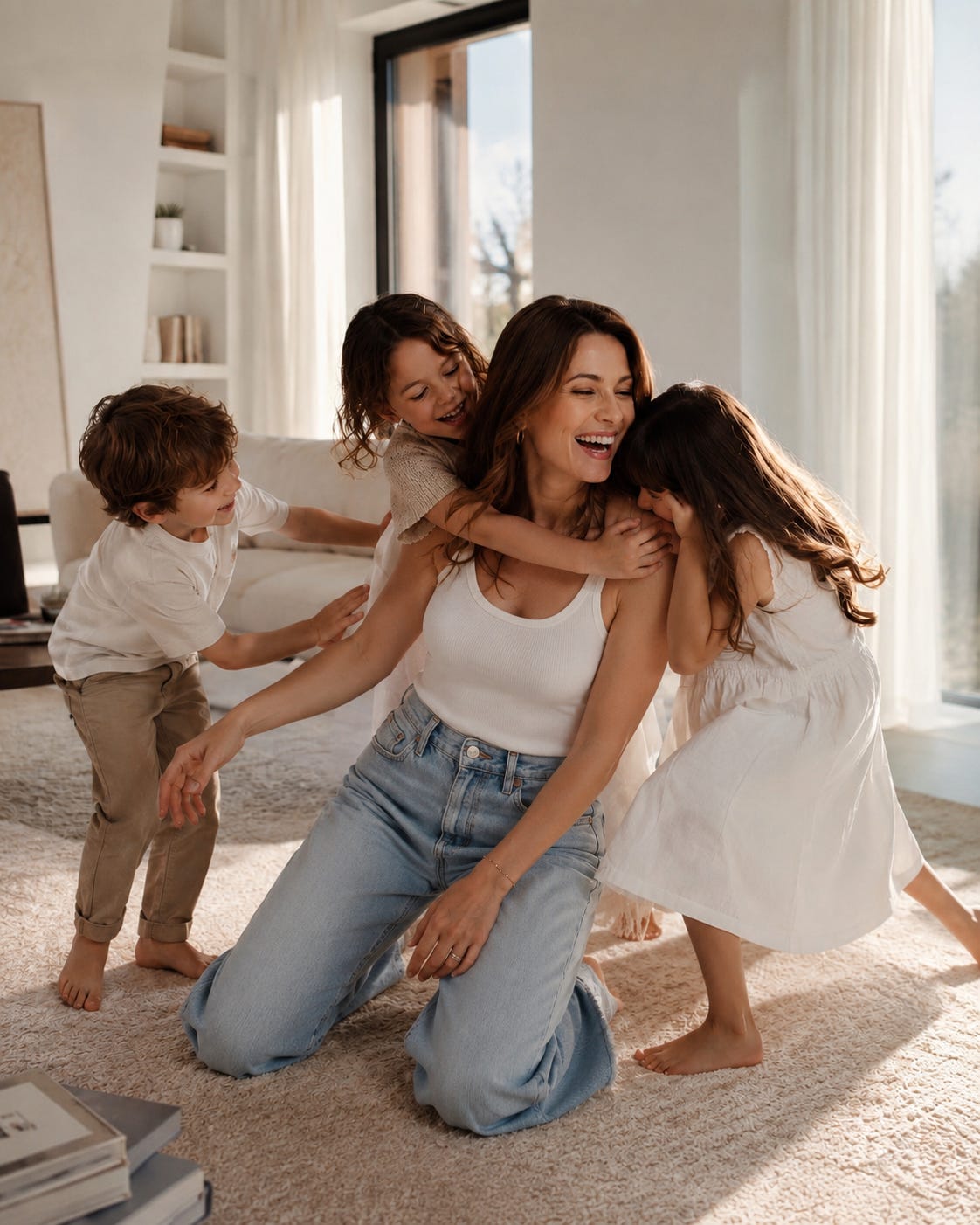
We joke about it constantly.
“My children gave me gray hair.”
“They are the reason I have wrinkles.”
“I used to take care of myself before I became a mom.”
“I’ll focus on me again when they’re older.”
And to be fair, motherhood can be exhausting.
Children interrupt sleep, stretch patience, fill our minds with worry, and make an already full life feel unmanageable. They need things the moment we finally sit down. They get sick when the calendar is packed. They introduce a level of responsibility that never fully turns off.
There is truth in that.
But it is only one side of the story.
At some point, we have to interrupt the pattern and ask a different question:
What if motherhood is not only aging you, but also helping keep you younger than you realize?
This is not about denial. It is about seeing aging through a more complete, evidence-informed lens.
We spend so much time counting what motherhood takes that we rarely notice what it may be giving back, and how that may shape the way we age.
Children Keep Us Actively Engaged in Life
One of the most powerful effects of raising children is simple: they keep us participating.
School mornings, practices, grocery runs, appointments, birthday parties, walks, vacations, holidays, projects, performances, and endless conversations create a life that requires showing up.
Even when we are tired, we still get up. We make breakfast, leave the house, solve problems, find missing shoes, remember appointments, answer questions, and keep the day moving.
Yes, it can feel overwhelming. But it also keeps us engaged.
It pulls us out of prolonged inactivity, isolation, and the ease of doing nothing.
Our children may be the reason we are tired. They are also often the reason we get out of bed.
Children Create Everyday Movement
Not all movement looks like exercise.
Sometimes it looks like carrying a growing child whose legs have suddenly stopped working the moment you reach the parking lot. It is pushing a stroller with twenty extra pounds of bags hanging from it, lifting car seats, carrying groceries, and repeatedly bending down to pick up toys you could swear you put away five minutes ago.
It is assembling toys, crawling across the floor to build a fort, and then climbing inside because apparently no fort is complete until Mom joins too.
As children grow, the movement changes. It becomes riding bikes, dancing together, roller-skating, playing in the pool, attempting cartwheels, walking through amusement parks, standing through practices and competitions, or running back into the house for the water bottle someone promised they packed.
None of it may feel like it counts.
But the body counts it.
Children create constant, incidental movement throughout the day. They shape our environment in ways that require us to lift, carry, bend, reach, walk, climb, build, chase, and move more naturally.
For many mothers, this becomes an invisible form of movement accountability. Without children, we might still be active, but there may also be more sitting, more postponing, and fewer built-in reasons to move.
Children make sedentary living harder to default into.
And that matters.
Children Shape Our Habits
Children become behavioral accountability partners without trying.
They need structure, so we build routines. They need food, so we plan and prepare meals. They need to go places, so we get dressed and leave the house. They want to play, so we move even when we would rather rest.
And they watch everything.
When we teach them to eat well, move, sleep, manage stress, or care for their bodies, we are forced to examine our own behavior.
It is hard to tell a child vegetables matter if we never eat them. It is hard to limit screen time while constantly looking at our phones. It is hard to teach self-respect while criticizing our own bodies.
Children make our habits visible. They reflect us back to ourselves, and often, the desire to model something better becomes the reason we begin changing.
Not because children are magical, but because they change the environment we live in and what we feel responsible for.
Children Give Us Purpose
Purpose does not always feel profound. Sometimes it is simply knowing someone needs you to show up.
Motherhood gives many women a reason to stay healthy, present, and engaged with the future. We want to be there for recitals, birthdays, graduations, heartbreaks, victories, and ordinary nights that later become memories.
Having someone to live for does not replace living for ourselves, but it often strengthens it.
It shifts our thinking from short-term comfort to long-term capacity. We begin to want energy, strength, mobility, clarity, and independence not just for today, but for years ahead.
We want to remain part of our children’s lives, not watch from the sidelines.
That future orientation quietly influences present choices.
Children Keep the Brain Active
Motherhood requires constant mental flexibility.
Plans change, questions come without warning, schedules overlap, and problems need quick solutions.
Children introduce new language, technology, interests, and perspectives. They ask questions we have never considered and force us to explain things we thought we understood. They stretch our patience, communication, and adaptability.
Yes, it can feel mentally exhausting. But it also keeps the brain engaged.
It introduces novelty, prevents life from becoming overly predictable, and pulls us into new conversations and experiences.
In a world where routine can narrow life over time, children often widen it.
Children Bring Back Play
Adults often stop playing long before they stop needing it.
Children reintroduce it naturally. They dance in kitchens, invent games, jump into pools, build forts, sing loudly, and laugh at things adults have stopped noticing. Their wild imaginations can turn a couch into a castle, a cardboard box into a spaceship, and an ordinary afternoon into an entire world.
They invite us back into creativity, spontaneity, and wonder. They remind us that movement does not always have to be structured and wellness does not always have to feel serious.
Sometimes it is chasing someone through the yard. Sometimes it is roller-skating badly. Sometimes it is singing in the car at full volume.
Play supports movement, creativity, laughter, and connection.
Most importantly, it brings us into the present, and presence is one of the most overlooked contributors to feeling young.
Children Keep Us Connected
Children expand our social world.
They bring us into schools, sports, neighborhoods, parent groups, events, and friendships we would not otherwise form. Some connections are brief. Others last for years.
But they create contact, community, and participation.
Social connection is not optional for long-term health. It is foundational. Without it, life can quietly narrow.
Children often widen it. They give us reasons to gather, maintain traditions, meet new people, and stay woven into the world around us.
Children Give Us More Reasons to Laugh
Motherhood includes stress, but also absurdity.
Children say unexpected things, misunderstand language, create chaos, and turn ordinary moments into lifelong family stories.
Laughter does not erase stress, but it changes how it lands. It releases tension, creates connection, and softens difficult seasons.
Some of the deepest laughter in life happens because of children.
And while the laugh lines may show up, so does the life behind them.
Children Keep Us Curious
Children see the world through questions.
Why does the moon follow us?
Why do people age?
Why do birds know where to go?
Why can’t we have cake for breakfast?
Their curiosity reawakens ours.
We revisit places, learn new things, watch different films, read aloud, and notice details we had stopped seeing.
Curiosity keeps life expanding.
And an expanding life rarely feels stagnant or old.
Children Shift How We Think About the Future
Before motherhood, health often feels personal.
After motherhood, it becomes generational.
We think more about what we model, what we normalize, and what our children will carry forward: how they will speak to themselves, care for their bodies, and understand food, movement, stress, aging, and self-worth.
This awareness often changes our daily choices.
We may eat better because we want them to. We may move more because movement becomes normal in the home. We may speak more carefully about bodies and aging, or become more intentional about rest, boundaries, and consistency.
Sometimes we begin taking better care of ourselves because we realize someone is learning how to live by watching us.
Motherhood Does Not Make Self-Care Impossible
“I don’t have time because I’m a mother” can feel completely true in certain seasons.
But as a permanent identity statement, it deserves questioning.
Motherhood does not eliminate self-care. It makes self-neglect easier to justify.
Those are not the same thing.
There are mothers working full-time while coordinating three or four children in entirely different directions. They move between school, sports, dance, appointments, homework, dinner, and work obligations, yet still find small ways to remain visible to themselves.
There is also a particular kind of strength many of us have witnessed in single mothers: women who worked more than one job, carried far more than anyone realized, raised remarkable children, and still protected some small ritual that helped them feel like themselves before walking out the door. Maybe it was doing their hair, adding a little lipstick, or simply refusing to let the weight of the day erase them completely.
Not because life was easy. Often, it was anything but.
That does not make these women better mothers, and it does not mean every woman has the same support, resources, health, energy, or circumstances. It simply reminds us that motherhood itself does not remove every possibility of caring for ourselves.
This is not about guilt. It is about possibility.
Sometimes the shift is not in the schedule. It is in the language.
Instead of saying, “I can’t take care of myself,” ask:
“What would taking care of myself realistically look like in this season?”
It might be one minute of skincare or a little tinted moisturizer before leaving the house. Getting dressed already has to happen. The choice can either disconnect us from ourselves or quietly bring us back. It takes no more time to choose the cute jeans over the oversized sweats, or a flattering top over the random T-shirt we keep reaching for. Sometimes the smallest choices are the ones that help us feel most like who we are.
Maybe there is no time to style your hair, but there is time for a sleek ponytail, a low bun, or a great baseball hat. It may be drinking water before the day takes over, walking during your child’s practice, eating the meal you already prepared, or going to bed instead of scrolling.
The goal is not perfection.
It is refusing to disappear from your own life.
The Love That Changes the Way We Live
Then there is the part that cannot be measured in steps, schedules, or healthy meals.
The love.
The kind of love that can make a mother feel overwhelmed, fiercely protective, terrified, grateful, and almost weightless within the same day. It can pull us beyond ourselves and create a level of motivation we may never have discovered alone.
That love gives ordinary choices a larger meaning.
We are not only trying to feel better today. We want to remain well enough to witness who our children become. We want to stay strong enough to participate, clear enough to guide them, and present enough to remember the life unfolding around us.
Love does not remove the fatigue or make every day easier.
But it can give us a reason to keep going through the days that are not.
And sometimes, being deeply loved and having someone to love so completely makes life feel fuller, brighter, and far more worth taking care of.
Reframing the Story
Yes, motherhood may change your body. It may bring gray hairs, fatigue, interrupted sleep, and seasons when you barely recognize yourself.
But perhaps we have spent too much time recording the evidence of what it took and not nearly enough time noticing what it built.
It built movement into days when we might have remained still. It brought play back into adulthood, expanded our social worlds, exercised our adaptability, and gave us reasons to laugh when life felt heavy.
It made our habits visible. It asked us to lead by example. It gave the future a face we loved enough to plan for.
Maybe motherhood did not only change your appearance.
Maybe it changed the way you live.
Maybe your children became behavioral accountability partners without either of you realizing it. Maybe they gave you more reasons to get up, move, learn, connect, care for yourself, and remain engaged with the world.
Maybe they gave you a reason to stay healthy long before you realized you were building a longevity lifestyle.
Yes, motherhood is exhausting.
But the same children we joke about aging us, may also be the reason we are more active, more connected, and more present than we would have been otherwise.
They keep us participating in life.
And sometimes, the life they pull us into is the very one that helps us age better.
A shift in perspective does not erase the hard parts.
It simply reveals the full picture.
And sometimes, seeing the full picture is what changes what we choose next.