

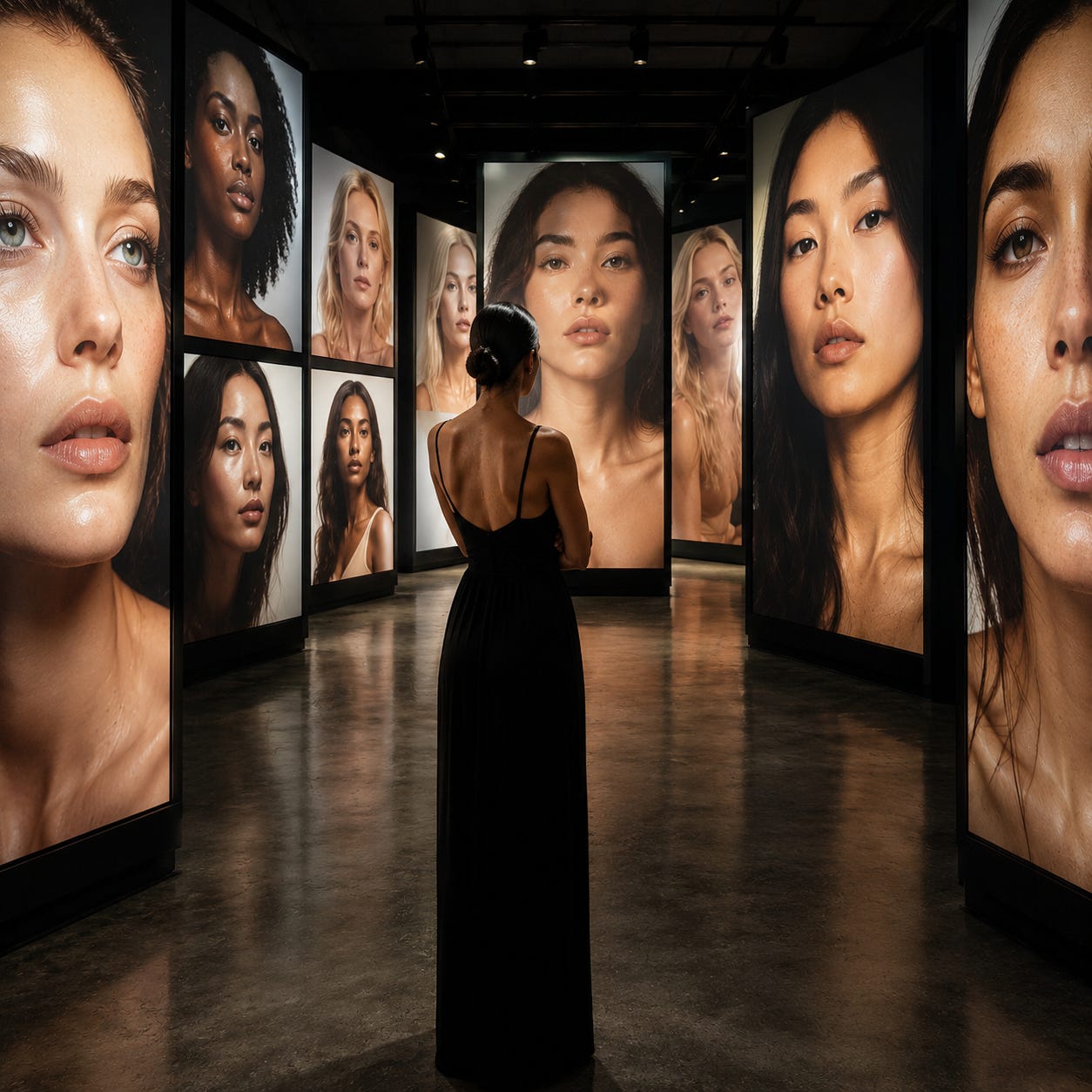
Long before Instagram, TikTok, beauty influencers, and algorithm-driven skincare routines, I heard the same request almost daily.
“I want my skin to look like hers.”
Sometimes “her” was a sister. Sometimes it was a friend. Sometimes it was a daughter, a mother, a coworker, or another patient they had seen in the waiting room.
Occasionally, it was me.
“What do you do?”
“I’ll have whatever you’re doing.”
The wording changed. The idea didn’t.
They wanted whatever treatment she received, whatever products she used, and whatever routine she followed. If her skin looked beautiful, they assumed the path should be the same.
What intrigued me was that the women being compared often shared almost nothing in common. They had different genetics, different ethnic backgrounds, different hormones, different lifestyles, and completely different histories of sun exposure, stress, sleep, nutrition, and skincare. Yet over and over again, people arrived convinced that someone else’s roadmap should become their own.
I spent years explaining the same thing.
Beautiful skin is not a formula you copy. It is an outcome shaped by variables most people never see.
The treatment that works beautifully for one person may be completely wrong for another. The product someone swears by may solve a problem you don’t have. The routine you admire may be addressing a skin concern you never experienced.
What people were really asking for was not a treatment.
They were asking for a result.
And somewhere along the way, the result became attached to a specific person.
That observation stayed with me.
Today, the pool of comparison has become almost limitless.
A woman can open her phone and encounter hundreds of examples of what beauty is supposed to look like before she even finishes her morning coffee.
What was once occasional comparison has become a constant stream of possibilities, recommendations, and carefully curated standards of beauty competing for attention.
The mistake is assuming that someone else’s outcome automatically contains your answer.
It doesn’t.
An outcome is visible. The factors that created it usually are not.
What we admire is often the final result, not the genetics, lifestyle, habits, environment, history, and biology that helped create it.
Today, the names have changed.
The psychology has not.
Before social media, comparison was local. Now it is global.
The women sitting across from me were still looking outward for answers. The difference was the size of the pool they were drawing from.
What was once a friend, sister, coworker, or neighbor has expanded into an endless stream of influencers, celebrities, creators, and strangers online.
The scale is different. The mechanism is the same.
We still look at someone else’s outcome and assume their path should become ours. Only now there are thousands of examples instead of a handful.
A woman can spend years learning what supports her own skin, what disrupts it, what improves her energy, what affects inflammation, what helps her sleep, and what makes her feel her best. Then one viral recommendation appears, and suddenly that entire body of personal experience becomes negotiable.
That is the part I find most interesting.
Not the products. Not the treatments. Not the influencers.
The willingness to abandon our own patterns in favor of someone else’s.
Over time, I became less interested in what people were buying and more interested in what they were borrowing: borrowed routines, borrowed goals, borrowed standards, and borrowed definitions of what beauty is supposed to look like.
Many women spend years chasing someone else’s reflection without ever asking a simple question:
Do I actually want what she has?
Or do I simply want how I imagine it would feel?
Those are not the same thing.
One of the quietest shifts in modern beauty is that personalization has become more available than ever while comparison has become more intense than ever. We know more. We measure more. We track more.
Yet many people have become less connected to the patterns shaping their own results.
The future of beauty may not be about finding better products, better procedures, or better influencers. It may be about paying closer attention to the patterns already influencing the outcome.
The goal was never to have someone else’s skin.
The goal was always to create the healthiest, strongest, most vibrant version of your own.
The skin you want may not be yours.
But the one you are capable of building might be better than you think.